Most double materiality assessments (DMAs) are run once a year, signed off, and filed away. Not because the conclusions stop mattering, but because keeping them current means months of manual rework: stakeholder surveys, workshops, spreadsheets, and a dedicated budget line. The result is a static snapshot that’s stale before it’s ever used strategically.
That’s precisely the gap Topic Monitoring, the newest capability in Datamaran’s Core solution, is built to close. It provides companies with a continuous, evidence-based read on how their materiality conclusions are holding up, turning the DMA from an annual snapshot into an ongoing, strategic process.
The regulation already demands this
Buried in the latest European Sustainability Reporting Standards (ESRS) requirements is a deceptively simple obligation (Section 3.1.4, paragraph 34):
“At each reporting date, the undertaking shall consider whether significant changes have occurred that could affect the conclusions of the materiality assessment conducted in previous reporting periods. If such changes are identified, the undertaking shall review and update the assessment.”
In practice, that’s a standing obligation to continuously track what’s moving in the operating environment, and act when something material shifts.
The problem is determining “whether significant changes have occurred” isn’t something a team can do from memory. A topic’s relevance shifts because regulations move, peers disclose something new, or a story breaks that changes how investors or communities read a risk. None of that happens on your reporting calendar. It happens continuously, across hundreds of sources, in a landscape no single person can watch unaided.
Without a system built for this, considering “significant changes” collapses into one of two things: a vague gut check nobody can defend to an auditor, or a full DMA re-run every time, just to be safe. A consultant can run you a fresh review, but that’s the same periodic, project-based approach the regulation is trying to move companies away from. A general-purpose LLM can summarize a topic on request, but it isn’t watching your DMA for a change, and it can’t hand an auditor a traceable evidence trail. Answering paragraph 34 of the ESRS properly takes a capability built specifically for the job: one that tracks your DMA over time and produces evidence a company can actually stand behind.
How Topic Monitoring works
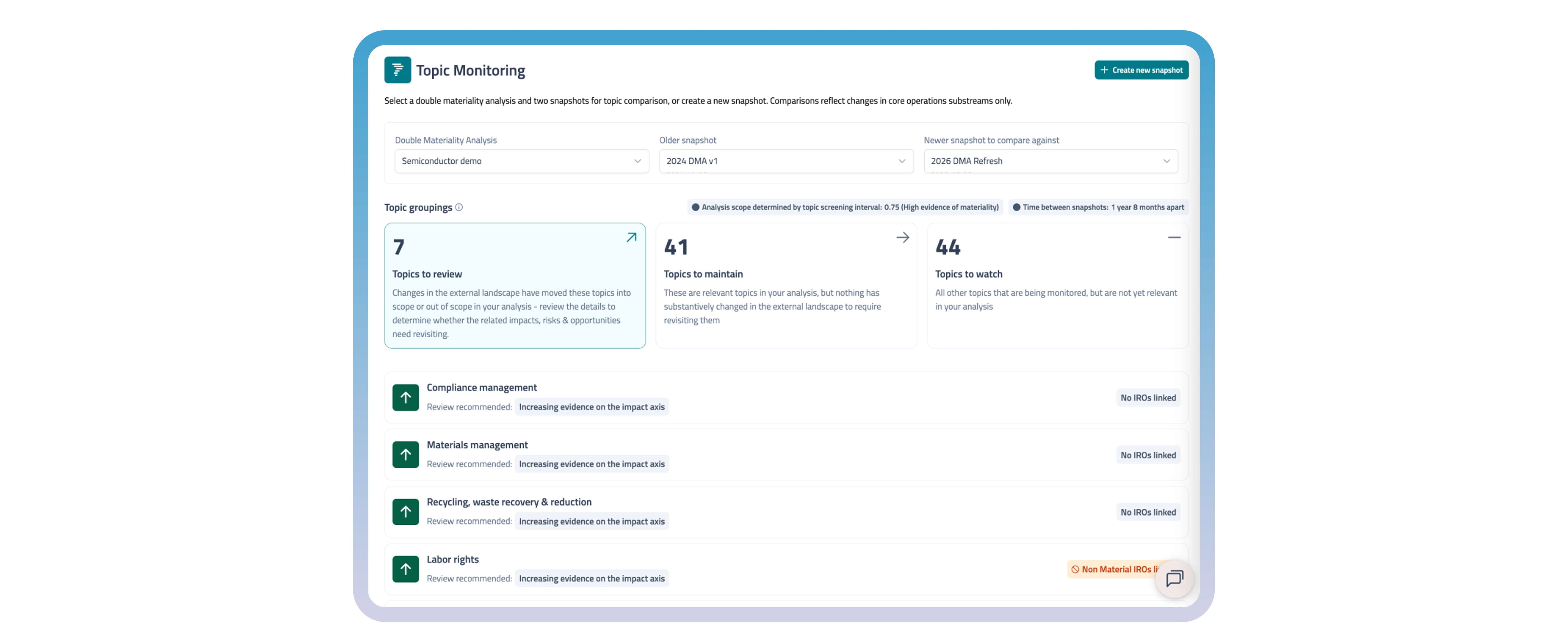
Topic Monitoring works by analyzing a DMA at two points in time to signal what has actually changed over that period. The comparison runs between a baseline, typically the oldest version of the analysis, and a more recent point in time, either an existing version or a new snapshot captured on the spot. The comparison overview then sorts every topic in the analysis into one of three groups: Topics to review (where a topic has moved in- or out-of-scope of the analysis), Topics to maintain (holding steady, or already reflected as material), and Topics to watch (currently outside the analysis purview, but kept visible rather than dropped).
Opening a flagged topic reveals exactly how its score moved on the financial and impact axes, along with the evidence behind that movement: the specific reports, regulations, and news stories that drove it, ranked by contribution.
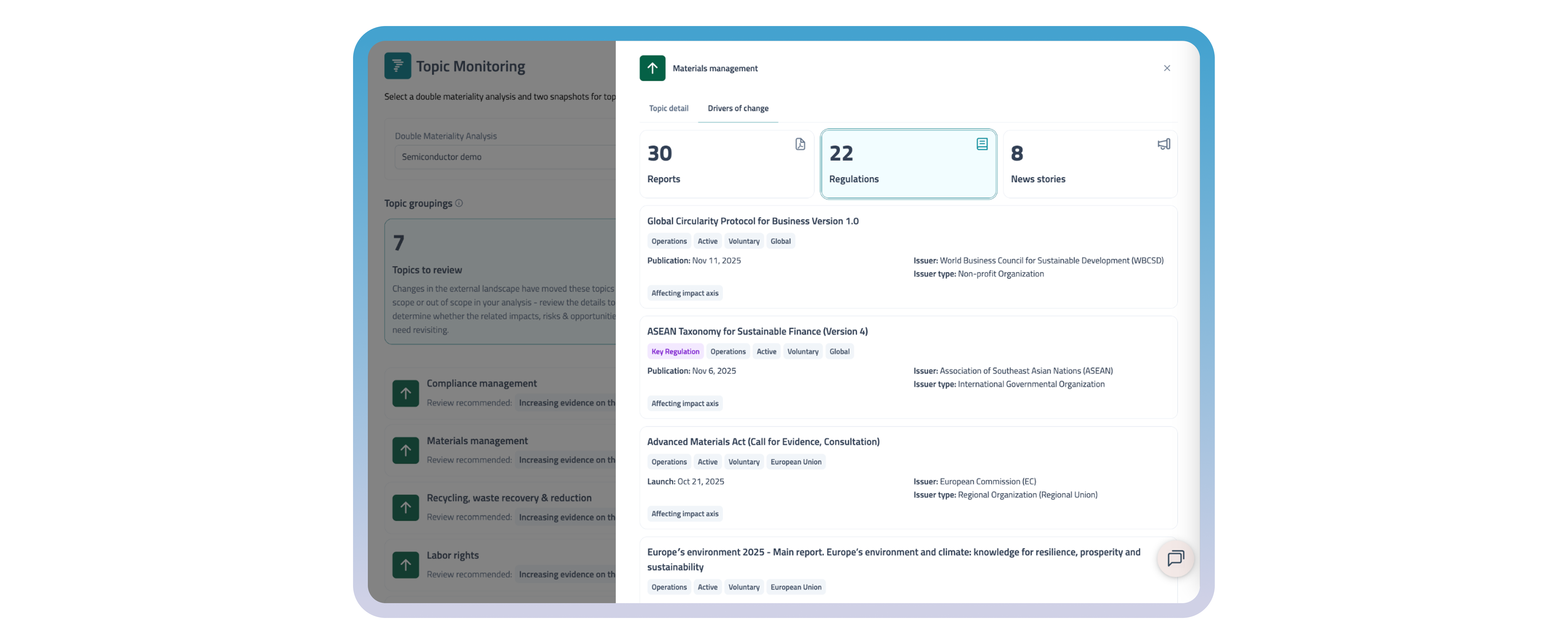
The result is a targeted review conducted on a meaningful cadence rather than a full DMA re-run: only flagged topics need attention, each backed by a clear evidence trail. You’re no longer asking “did anything change?” – you’re looking at a synthesized view across regulations, peers, and news, and gaining a clear answer.
From annual project to targeted update
The practical payoff: instead of re-initiating the entire materiality assessment every reporting cycle, a company using Topic Monitoring sees exactly which topics moved and why, and updates only those. The rest of the DMA stands, because the record shows nothing material shifted underneath it.
That’s a fundamentally different posture than the once-a-year fire drill most teams are used to – targeted and proportionate to what actually changed. Datamaran customers already see the impact of that shift: IFS reported 72% time savings conducting their DMA on Datamaran Core versus their prior manual approach. And Zain recovered 75% of the time they’d previously spent on it to focus on more strategic work. Layer in Topic Monitoring alongside the other Omnibus simplification measures baked into Datamaran, and we expect efficiency gains of 85% or higher, especially for annual refreshes where most of the DMA no longer needs to be touched. And it also produces exactly the kind of audit trail regulators and assurance providers expect: a running, evidence-based log of how and why your materiality conclusions evolved, rather than a single static document dated to whenever the project happened to end.
The bigger point: governance
We’ve said from the start that the CSRD is a governance regulation wearing a reporting wrapper – it’s asking companies to know their material risks and impacts, and manage them with the same rigor they’d apply to any other strategic exposure.
Continuous topic monitoring is simply that operating discipline applied to a set of impacts, risks and opportunities that used to get a once-a-year glance, giving leadership something to actually discuss: where the ground is moving and where a strategic conversation (not just a disclosure update) might be overdue. That’s governance doing its job.
The companies that build this muscle now, treating materiality as a living, monitored process rather than an annual reporting task, will be better prepared for their next CSRD filing and make sharper, faster, more-informed decisions about the risks and opportunities that matter most to their business.
Ready to see what Datamaran can do?
Topic Monitoring is available now as part of Datamaran’s Double Materiality module. If you’d like to see how it works with your own DMA, book a demo; we’re happy to walk you through it. Existing Datamaran Core subscribers automatically have access.

 2 min read